
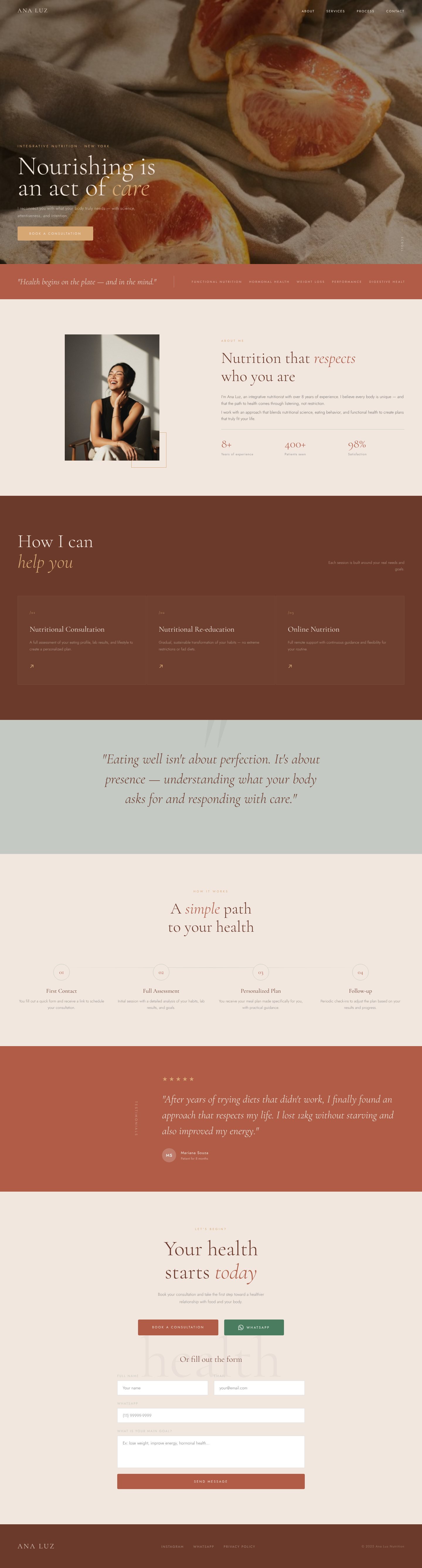
Someone lands on your nutritionist website after a search, a referral or the link in your Instagram bio. Before they read a single paragraph, they are already asking a few quiet questions: Is this for me? Can she help with my situation? What do I do next?
A good nutritionist website answers those questions on every page, and makes the next step easy. Here is what we put on each page of the nutrition websites we design.
The homepage: four answers before anyone scrolls
The top of the homepage should answer four things. Who you help, in your client's words: "Nutrition support for women navigating PCOS, without strict meal plans" lets the right person recognize herself at once. What changes after working with you, as one honest sentence, not a medical claim. How you work: online or in person, where you are based, one to one or in groups. And one clear next step, usually a free discovery call, written as an invitation: "Book a free 15 minute call" is clearer than "Get started".
Further down, a short introduction with a warm photo of you, your main programs and the same button again at the end.
The about page: your story and your credentials
People choose a nutritionist they trust and feel comfortable with. Tell them why you do this work and what your approach feels like, then your qualifications, years in practice and specialties near the top. Clear credentials also help search engines and AI tools understand who you are and trust your site.
Programs and packages: one clear page each
One offer fits on one page. If you have several programs, packages and one to one work, give each its own section or page: who it is for, what is included, how long it lasts and what it costs or where it starts. Specific pages turn visitors into clients better than one generic "services" list, and they help you be found for the exact searches your clients make.
Booking: three clicks or fewer
Count the clicks from your homepage to a booked call. Three or fewer is the goal. Every extra step, a long form, a separate page, a confusing calendar, is a moment where someone decides to come back later, and often does not. Use the same button and the same booking link everywhere. If you use a booking tool, link straight to the free call instead of a page with every appointment type, and say on the button how long the call takes, so people know what they are saying yes to.
Proof: testimonials and real details
At least one real testimonial on the page itself, with your client's permission, about the experience of working with you. Short and specific beats long and general. Add small trust details too: where you trained, professional memberships and a clear privacy note on your contact form.
Start with what helps a client book you. Everything else can wait for its moment.
What a nutritionist website costs
These are typical ranges for a small practice in 2026. Doing it yourself on a website builder costs around $300 to $600 a year in plans, plus your own time. A designer personalizing a template costs from about $500 to $3,000, depending on how much is adapted for you. A site designed from scratch goes from around $1,000 for a single page to $10,000 or more for a large site with many pages and features.
Inside each range, the difference is mostly experience, how much strategy goes into the layout and how efficiently the studio works. A higher price does not always mean a better site. Your domain and hosting are paid separately and should stay in your name: a small yearly fee for the domain and a monthly plan for hosting.
What it costs with Delas
These are our own prices. Every site includes basic search setup, a design that works well on phones and a simple panel to change your texts, photos and colors.
- Website in a Day: one page built from one of our templates and live in a day, $497 with our launch offer until December 31, 2026 (regularly $697).
- One-Page Web Design: one page designed from scratch around your practice, $997 with the launch offer (regularly $1,297).
- Multi-Page Web Design: separate pages for your programs, about and booking, $1,697 with the launch offer (regularly $1,897).
Want to see what this looks like in practice? Browse our portfolio or contact us to talk about your practice.
Questions nutritionists ask
A template is genuinely enough to start, especially with one clear offer. A custom site suits practices with several programs or a specialty that needs its own words and layout.
A template site can go live in a day. A custom site usually takes two to six weeks, depending on how quickly you send feedback on each round.
If your packages have fixed prices, show them, or at least a starting price. Visitors who cannot find a number often assume it is too high for them.
You should. Register both in your own name, whoever builds the site, so you can move or change it later.