
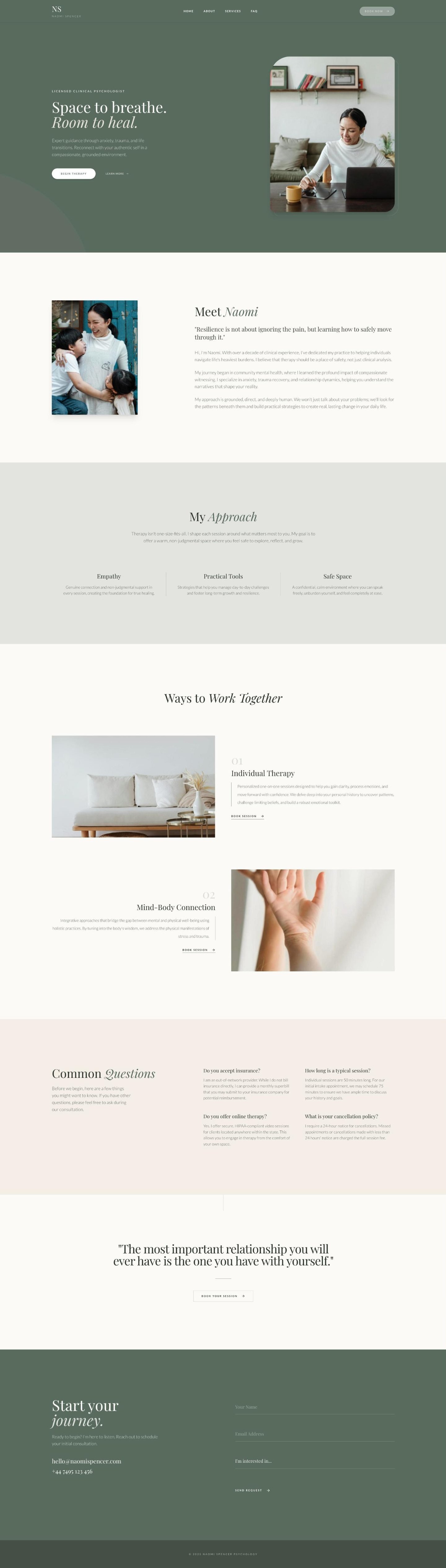
A therapist website has one quiet job: to help the right person feel safe enough to reach out. People often look at several therapist websites before they contact anyone, and many do it late at night, when things feel heavy. They are not comparing designs. They are looking for signs that this person understands them and that working together is possible.
Here is what we include on every therapist website we design, page by page, and what we leave out.
The homepage: who you help, in their words
The first line should describe your client, not your title. "Individual therapy" describes a service. "Support for women going through burnout, anxiety or big life changes" describes a person. Write the sentence your ideal client would recognize, using the words they would use, not clinical terms.
Right below it, answer the practical question every visitor has: is this possible for me? Online or in person, the state or states where you are licensed, and whether you offer a free first call. Then one gentle next step, the same button across the whole site. For many people, booking a full session feels like too much, so "Book a free 15 minute call" is easier to say yes to than "Book now".
The about page: a bio that sounds like you
Most visitors read the about page before they decide. Start with the person, not the resume: why you do this work and what a session with you feels like. Then your training, license and approach, explained in everyday words. Most people do not know the difference between approaches, and they do not need to.
A warm, natural photo matters more here than anywhere else. It answers "who will I be talking to?" faster than any sentence.
Services and specialties: one clear section each
If you work with a few specific situations, give each one its own short section or page: who it is for, what usually brings people in, and how you help. Specific pages make visitors feel understood, and they also help Google show your site to people searching for that exact kind of support.
Avoid long lists of every modality and certification. Three or four clear specialties say more than fifteen bullet points.
Fees, insurance and how sessions work
This is the page many therapists skip, and the one visitors look for most. Say how long sessions last, what they cost or where to find that information, whether you take insurance or offer superbills, and your cancellation policy. Clear details answer the silent question "can I afford this?" before it becomes a reason to leave.
Contact: short, private and kind
Keep the contact form short: name, email, how they prefer to be contacted and a small optional message. Never ask for health details or a description of symptoms in the form. That conversation belongs in your first call. Add a short line about when you reply, and a note that the form is not for emergencies, with where to go instead.
What to leave out
Stock photos of people holding their head in their hands, urgent language, pop-ups and anything that feels like a sales page. Check your professional rules before adding testimonials, since many therapists cannot use them. A good therapist website feels like the first five minutes of a good session: calm, clear and kind.
Visitors are not comparing designs. They are looking for signs that you understand them.
What a therapist website costs
The price depends mostly on who does the work. Building it yourself on a website builder costs about $300 to $600 a year in plans, plus 20 to 40 hours of your time, according to TL Design Studios' 2026 guide for therapists. Therapy website platforms charge about $59 to $99 a month. A designer personalizing a template usually costs from about $500 to $3,000, and a site designed from scratch starts at around $1,000 for a single page. Whatever you choose, budget about $12 to $20 a year to renew your domain, and register it in your own name.
What it costs with Delas
These are our own prices. Every site includes basic search setup and a design that works well on phones, and the site and domain stay in your name.
- Website in a Day: one page built from one of our templates, $497 with our launch offer until December 31, 2026 (regularly $697).
- One-Page Web Design: one page designed from scratch for your practice, $997 with the launch offer (regularly $1,297).
- Multi-Page Web Design: home, about, specialties, fees and contact as separate pages, $1,697 with the launch offer (regularly $1,897).
If you would like to see how we design for therapists, take a look at our portfolio or contact us to talk about your practice.
Questions therapists ask
Four or five is enough for most solo practices: home, about, services or specialties, fees and contact. A single, well organized page also works when you are starting out.
Yes, if you are comfortable with it. Choosing a therapist is personal, and seeing your face helps people imagine talking to you.
Check your professional association's rules first. Many ethics codes discourage or forbid client testimonials for therapists, so most practices use other trust signals, like credentials and a clear explanation of how they work.
Only if you can keep it up. A few helpful articles about the questions your clients ask can help people find you on Google, but an empty blog does more harm than none.