
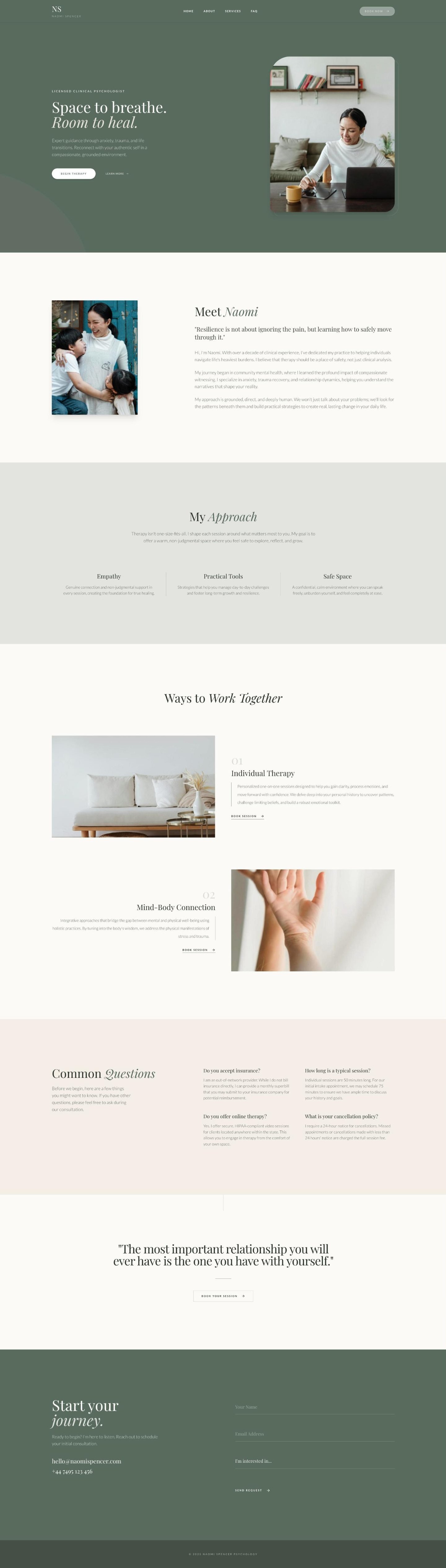
Most therapist bio examples you find online start the same way: a name, a list of degrees and a sentence about being passionate about helping people. Then a visitor reads three or four of them in a row and they all blur together.
Your bio has a different job. It is often the page where someone decides whether to reach out, so it should speak to them first and to your résumé second. Below is the structure we use when we write about pages for therapists, with examples you can adapt for your website and your directory profile.
Open with the person you help
The first two or three sentences matter most. SimplePractice's guide to directory profiles notes that only the first 200 characters of a Psychology Today profile show on the search page, so those opening lines decide whether anyone clicks. The same is true on your website: many visitors read the top and skim the rest.
Start with your client, not your title:
"You are doing everything right on paper, and still feel like you are running on empty. I help women in demanding careers slow down, understand what is driving the exhaustion and find a pace they can keep."
Compare that with "I am a licensed clinical social worker with 12 years of experience." Both are true. Only one makes the right person think "this is me."
Explain how you work, in plain words
Next, describe what working with you is actually like. SimplePractice suggests explaining your approach in terms of how it helps clients, and spelling out acronyms like CBT, DBT, IFS or EMDR, since terms people do not understand can send them to another profile.
"In our sessions, we look at the thoughts and habits that keep you stuck, using an approach called cognitive behavioral therapy. It is practical: you leave each session with something small to try that week."
Say whether you see clients online or in person, and roughly what the first sessions look like. These details lower the uncertainty that stops people from booking.
Then your training and credentials
Credentials still matter. They answer "is this person qualified?" They just do not belong in the first line. TheraPlatform's therapist bio examples follow a clear order: an introduction with who you serve, then your background, degrees and certifications, then your approach.
"I am a licensed marriage and family therapist (LMFT) in California, trained in emotionally focused therapy. Before private practice, I spent six years at a community counseling center."
Keep this part short. If you have a long list of trainings, choose the three that matter most to the clients you want.
Add one human detail
A line about who you are outside the therapy room helps people imagine talking to you. TheraPlatform suggests a hobby or interest that makes you relatable, and SimplePractice notes that a personal connection often moves readers to reach out.
"When I am not in session, you will probably find me on a trail with my dog, or failing, happily, at sourdough."
One sentence is enough. The goal is warmth, not a full autobiography.
Close with a gentle next step
End your bio with an invitation, not a sales line. Say whether you are accepting new clients and what the first step is.
"If this sounds like what you have been looking for, book a free 15 minute call. We will talk about what is going on and whether we are a good fit."
Use the same button and the same wording you use on the rest of your site, so the path to booking feels familiar.
A good bio reads like the first minute of a first session: calm, clear and about the person in front of you.
Website bio vs directory profile
Your website bio and your directory profile do different jobs:
- Website: about four short paragraphs, usually in first person, with a warm photo. This is where people go after they have found you somewhere else.
- Directory profile: one paragraph that fits the platform's limit. SimplePractice notes that Psychology Today allows 1,360 characters, so write the full version first and cut until it fits.
- Social media bio: one line with who you help and a link to your website.
Write the website version first. The other two are shorter cuts of it.
Mistakes that make people click away
- Starting with credentials. Keep them, just not in the first line.
- Writing for colleagues. Clinical terms impress other therapists, not clients.
- Talking only about yourself. Every paragraph should connect back to the reader.
- No next step. A bio without an invitation leaves people unsure what to do.
- An old photo or no photo. People want to see who they will meet.
If you would like help turning your bio into a full about page, our Website in a Day builds a calm, clear one-page site from one of our templates, and a one-page website is designed from scratch around your practice. You can see examples in our portfolio.
Questions therapists ask about their bio
On your own website, first person usually feels warmer, because it sounds like you talking. Directory profiles and short professional listings often use third person. Pick one per place and keep it consistent.
About four short paragraphs on your website, one paragraph on a directory and one line on social media, as TheraPlatform suggests. Put the most important sentence first everywhere.
A small personal detail helps people imagine talking to you. One line is enough, and it should feel natural, not like a dating profile.
Yes, if you are comfortable with it. A warm, recent photo answers the question "who will I be talking to?" faster than any sentence.
An about page that sounds like you, on a site that feels like you.
Website in a Day, from $497 (launch offer until Dec 31, then $697).
See the options