
Health coach marketing is hard at the start for a simple reason: you are selling something people cannot see before they buy. They cannot taste a coaching session or try on a program. So they look for signs that you understand someone like them, and if they cannot find those signs quickly, they keep scrolling.
When we read the guides that rank for this search, from ISSA, the American Council on Exercise, Carepatron and others, they offered long lists: blogs, Pinterest, Quora, flyers, podcasts, events. All of it can work, but a new coach cannot do thirteen things at once. And none of the guides we read explained what to do on a discovery call, or how to talk about results without crossing into health claims, which is where many coaches get stuck.
The short answer: say who you coach and what changes for them, package one signature program with a price, put it on a simple website whose only ask is a discovery call, run that call so it ends in a decision, and get in front of people through partners and one channel you enjoy. Describe the process, not guaranteed results.
1. Say who you coach and what changes for them
ISSA's guide on how to market yourself as a health coach puts it plainly: "Know who you want to work with first, before doing any marketing." The same guide notes that there are no formal requirements to work as a health coach, which is exactly why a clear focus matters. Anyone can call herself a coach. Not everyone can say who she helps.
Write one sentence with two parts: the person and the change. "Health coaching for nurses on night shifts who want steadier energy" or "Coaching for women in their 40s who want to build an exercise habit that lasts". The right reader sees herself in it at once. Use the same sentence on your website, your profiles and every message you send to partners.
2. Package one signature program with a price
Most new coaches offer "sessions". People find it hard to buy sessions, because they do not know how many they need or what happens at the end. A program answers both: a name, a length, what is included and a price. For example, twelve weeks, one call every other week, a check in message between calls and a short plan for each phase.
Start with one program. Two or three choices make people postpone the decision, and a single offer is easier to explain in one breath. You can add a shorter starter option or a group version once the first program fills.
3. Give people one place to book a discovery call
The American Council on Exercise's CERTIFIED magazine quoted coach Andre Hills on this: "A website is absolutely essential." We agree, with one condition: the site should ask for one thing. For a health coach, that is a free discovery call.
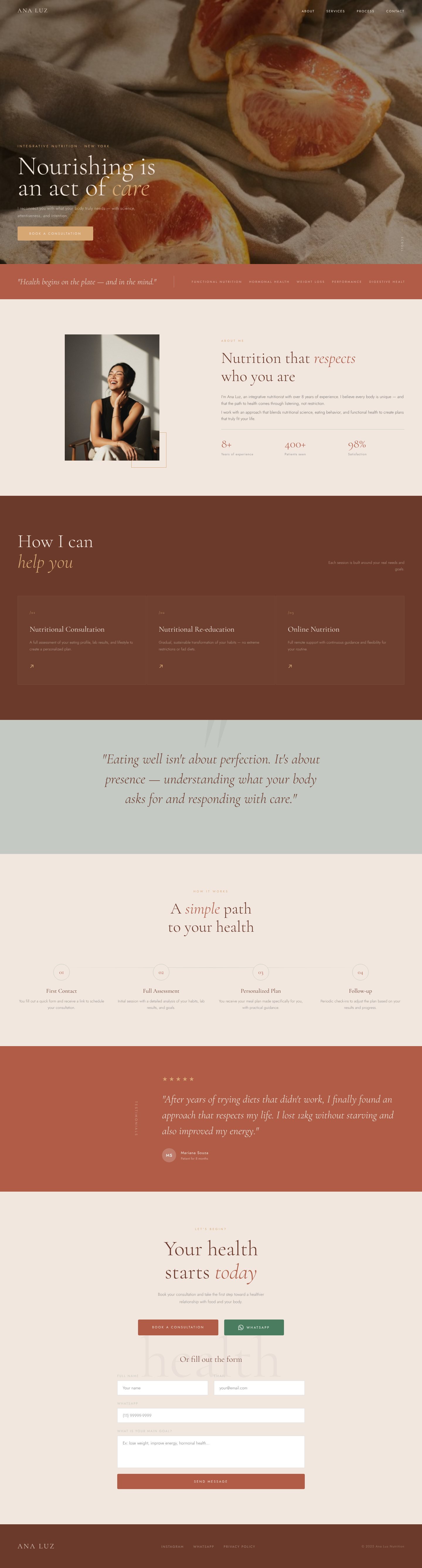
A first website for a coach can be one page. At the top, your sentence and a warm photo of you. Below it, your signature program with its length and starting price, a short about section with your certification, a few words from clients when you have them, and the same "Book a free call" button repeated three or four times. Keep the booking form short and do not ask for health details before the first conversation. A Website in a Day site holds all of this on one page, built from one of our templates and live in a day. We go through each page in more detail in our guide to a health coach website.
4. Run the discovery call so it ends in a decision
A discovery call is a short free conversation where you and a possible client decide whether to work together. It is not a free session. If you start coaching on the call, she leaves with a few tips and no reason to sign up.
We suggest 20 to 30 minutes in three parts. First, ask what she wants to change and what she has already tried, and listen. Second, explain how your program works, how long it lasts and what it costs, in plain numbers. Third, ask if she would like to start, and send the payment or sign up link while you are still on the call. If she needs time, agree on a day to follow up, and write it down.
A discovery call is not a free session. It is the moment she decides, so make deciding easy.
5. Get in front of people through partners and one channel
Most of the marketing strategies for health coaches in the top guides come down to the same idea: go where your future clients already are. ISSA and Carepatron both suggest connecting with related professionals, and ISSA adds seminars and workshops. For a coach, good partners are personal trainers, yoga and pilates teachers, physical therapists, dietitians and doctors who see people you can help with habits. Make a list of ten and contact two a week with your sentence and your website link.
Then choose one channel you enjoy and can keep up: Instagram, a monthly email, a free workshop on Zoom, or articles on your site. One channel done steadily brings more calls than four done for a month and then dropped.
Talk about results without promising them
This is the part most guides skip. The National Board for Health and Wellness Coaching (NBHWC), which certifies health coaches in the US, says in its scope of practice that coaches on their own do not diagnose, prescribe, recommend supplements, create meal plans or give exercise prescriptions. It describes the coach as an "accountability partner, not director". Your marketing should match: talk about habits, support, structure and follow through, not about treating anything.
Testimonials help, and you should use them. Ask happy clients for a few lines about what working with you was like, and quote them with their OK, signed with a first name. If a testimonial mentions a specific result, like pounds lost, the FTC Endorsement Guides expect that result to be typical, or that you say what most clients can expect right next to it. As health care lawyer Michael H. Cohen explains in his summary of the guides, "results may vary" on its own is not enough.
Where articles and ads fit
Articles on your own website answer the questions your future clients type into Google, and they keep bringing visitors as long as new ones keep coming. That steady pace is hard when you are also coaching. It is why we are opening Rooted SEO, opening soon with a waitlist: we write and publish search friendly articles on your site every day.
Ads on Instagram and Facebook can fill your calendar faster once your website explains clearly who you help and what your program is. For that step, our Meta Ads service is also opening soon, with a waitlist.
What it costs with Delas
If a website is the missing piece, these are our current prices. Every site includes basic search setup, a design that works well on phones and a simple panel to change your texts and photos.
- Website in a Day: one page from one of our templates, live in a day, $497 with our launch offer until December 31, 2026 (regularly $697).
- One-Page Web Design: one page designed from scratch around your coaching, $997 with the launch offer (regularly $1,297).
- Multi-Page Web Design: separate pages for your program, about, articles and booking, $1,697 with the launch offer (regularly $1,897).
You can see wellness and nutrition websites we designed in our portfolio, or contact us to talk about your coaching practice.
Questions about health coach marketing
No, not on your own. The NBHWC scope of practice says coaches do not create meal plans, prescribe or recommend supplements, so market the habits and accountability you help with, and refer meal planning to a dietitian.
Yes, at least a starting price, such as "from $600 for 12 weeks". It filters out people who cannot afford it before the call, so your discovery calls are spent with people who can say yes.
Yes, if that result is typical for your clients, or if you say next to it what most clients can expect. Under the FTC Endorsement Guides, a line like "results may vary" on its own is not enough.
20 to 30 minutes, in three parts. Ten minutes on what she wants to change, ten on how your program works and what it costs, and the last few on a clear next step, with a link to start.
A health coach website that books discovery calls.
Website in a Day, from $497 (launch offer until Dec 31, then $697).
See the options