If you are figuring out how to start a nutrition coaching business, you have probably read guides that cover business plans, LLCs, coaching apps and income projections. They are useful. But they skip the questions a new coach actually gets stuck on: what am I allowed to offer where I live, what will I sell first, and where do people go to book me?
We build websites for nutrition professionals, so we see what new coaches have ready, and what is missing, when they come to us. This guide puts the online side in order, for a woman starting on her own.
The short answer: start by checking what your state allows a nutrition coach to do, then choose a certification and budget about $860 to $1,030 for it and insurance. Package one coaching offer with a price, set up booking and payments, and put it all on a simple website whose only ask is a free discovery call.
1. Check what your state allows before you write a word
This is the step most guides cover in one vague line, and it shapes everything else, from your title to your sales page. The National Association of Nutrition Professionals (NANP) sorts US states into three groups:
- No law states. NANP names California, Washington State, Colorado, Arizona and Maine as states with no restrictions on who may provide nutrition advice, though some protect specific titles.
- Title protection states. The title nutritionist is protected, and you may not imply you are a dietitian or licensed by the state.
- Exclusive scope states. A license is required to provide nutrition care. NANP explains that without one you may share general nutrition information, but you may not individualize dietary recommendations or assess a client's nutrient status.
Coaching online adds one more layer. ZenBusiness notes in its guide that virtual coaching across state lines can bring extra compliance checks depending on where the client lives, not only where you live.
Everywhere, the line is the same: Coachway's guide to starting an online nutrition coaching business says a coach cannot diagnose a condition, treat disease or prescribe clinical nutrition, which stays with registered dietitians. Write one sentence for your website and your intake form that says what you do, for example "I help busy moms build steady eating habits. I do not diagnose or treat medical conditions."
2. Choose a certification and set a starting budget
In many states no law requires a certification, but clients and referral partners look for one. Coachway's 2026 breakdown lists $629 for the ISSA Certified Nutrition Coach and $799 for Precision Nutrition Level 1, plus liability insurance from $234 a year, for a total of about $860 to $1,030 before your first client.
ZenBusiness adds the other startup pieces: $50 to $300 to register an LLC and $100 to $250 a year for a domain and hosting. Put your certification name on your website next to your photo. For a new coach it is the quickest trust signal a visitor sees.
3. Package one coaching offer with a price
People find it hard to buy "sessions", because they cannot tell how many they need. A package answers that: a length, what is included and a price. ZenBusiness puts nutrition coaching packages at $200 to $1,500.
Start with one offer, for example eight weeks with a call every other week and a check in message between calls. Name it after the change your client wants, not after your method. A second offer can wait until the first one fills. We go deeper into packaging and running the discovery call in our post on health coach marketing.
One offer, one price, one button. A new coach does not need more choices, she needs a clearer one.
4. Set up booking, payments and a short intake
Before you send anyone to your website, the booking link has to exist. Coachway points out that Cal.com has a free plan for one user, which is enough for discovery calls at the start. Connect a payment link so a client can pay while you are still on the call.
Keep the booking form short: name, email and one question about what she wants help with. Save detailed questions for the intake form she fills in after she signs up, and put your scope sentence from step 1 at the top of it.
5. Build a website that books the first call
A future client who hears your name from a friend, a trainer or a reel looks you up before she books. If all she finds is an Instagram grid, she has to piece together who you help and what it costs. One clear page does that for her.
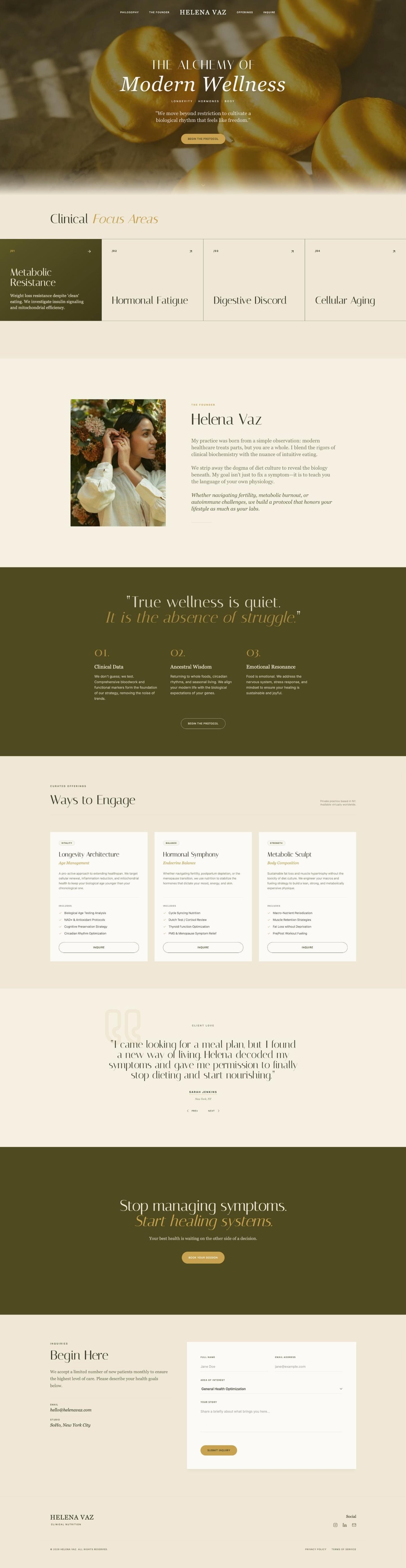
For a new coach, that page holds your one sentence about who you help, a warm photo, your certification, your offer with its length and starting price, a short scope line, a few words from clients once you have them, and a "Book a free call" button repeated three or four times. Quote client words with her OK, signed with a first name, like "Mariana", and if one mentions a specific result, say next to it what most clients can expect.
This is what our Website in a Day is built for: one page from one of our templates, live in a day, with basic search setup included. If you are still deciding how to start an online nutrition coaching business, a page like this is often the piece that turns interest into booked calls. See finished examples in our portfolio.
Where articles and ads fit later
Articles on your own site answer the questions future clients type into Google, and they keep bringing visitors as long as new ones keep coming. That pace is hard while you are coaching, which is why we are opening Rooted SEO, opening soon with a waitlist, to write and publish them on your site every day.
Ads on Instagram and Facebook work best once your website explains clearly who you help and what your offer is. When you are ready, our Meta Ads service, also opening soon with a waitlist, runs them for you.
What it costs with Delas
If the website is your missing step, these are our current prices. Every site works well on phones, includes basic search setup and stays in your name.
- Website in a Day: one page from one of our templates, live in a day, $497 with our launch offer until December 31, 2026 (regularly $697).
- One-Page Web Design: one page designed from scratch around your coaching, $997 with the launch offer (regularly $1,297).
- Multi-Page Web Design: separate pages for your offer, about, articles and booking, $1,697 with the launch offer (regularly $1,897).
- Visual Identity: logo, colors and fonts for your coaching brand, $697 with the launch offer (regularly $897).
Once your first clients are booked, ask each one how she found you. Those answers tell you where to spend your next month. If you would like a hand with the website part, contact us.
Questions new nutrition coaches ask
Not in every state. The National Association of Nutrition Professionals (NANP) says the title nutritionist is protected in many states, so "nutrition coach" plus the name of your certification is the safer title for your website and bio.
About $860 to $1,030 before your first client for a certification and a year of insurance, according to Coachway's 2026 breakdown. Add a domain, a booking tool and a website on top of that.
States with no nutrition practice law, such as California, Washington, Colorado, Arizona and Maine, which NANP lists as having no restrictions on who gives nutrition advice. In states with exclusive scope laws, you can share general nutrition information but not individualized dietary recommendations.
Yes, if you want people you do not know yet. Friends can book you from a message, but anyone who hears your name from a client or a partner will look you up first, and one page with your offer and a booking button answers her in a minute.
A nutrition coaching website that books discovery calls.
Website in a Day, from $497 (launch offer until Dec 31, then $697).
See the options