
If you are figuring out how to start a private practice, you have probably already read the big guides. They cover the essentials well: choose a business structure, get liability insurance, decide between private pay and insurance, find an office. Then they reach the part about getting clients and say something like "build an online presence," and stop.
That line hides most of the work a new practice does in its first months. Which accounts do you need? In what order? What does each one cost, and what can wait?
This guide covers only the online side, the five steps we walk through with therapists who are opening their own practice. The legal and clinical decisions belong to your licensing board, your accountant and your attorney. What follows is how people will find you and reach you once those are in place.
Get your NPI and settle your practice name
Your NPI, or National Provider Identifier, is the number that identifies you as a health care provider. You need it to join insurance panels, and insurance platforms like Headway use it for credentialing. According to Headway's guide, you apply online through NPPES, the federal system that issues the numbers, and it is always free. Headway notes that error free applications often get a number within 24 hours, though verification can take up to 30 days. Anyone asking you to pay for an NPI is not legitimate.
There are two types. Type 1 is for you as an individual. Type 2 is for an organization, such as a group practice with its own tax ID. A solo therapist usually starts with Type 1.
While you wait, settle your practice name, because it will appear everywhere: your website address, your email, your Google listing and your directory profile. Before you commit, check three things. Is the name free to register in your state? Is a matching web address available? Is it easy to spell when you say it out loud on the phone? Using your own name, like "Jane Rivera Counseling," avoids most of these problems and travels with you if you move.
Set up a professional email and a safe way to reach you
Buy your web address (the domain) and create an email on it, like hello@janeriveracounseling.com. It looks more trustworthy than a personal Gmail address, and it keeps work and personal messages apart.
Then think about what people will send you. The US Department of Health and Human Services says in its HIPAA guidance that providers may email patients if they use reasonable safeguards, that unencrypted email is not forbidden, and that providers should limit the amount or type of information they include. It also says that if a patient starts the email exchange, the provider can generally assume email is acceptable unless the patient says otherwise.
In practice, we keep website contact forms short on purpose: name, email or phone, and a preferred way to be contacted. No box asking why the person is seeking therapy. A short line above the form, like "Please do not share health details here, we will talk about that on our first call," protects your future clients and you. If you want secure messaging, use the one built into your practice management software rather than the website form.
Build a simple website before you need it
Almost every new client will look you up before they reach out, even when a friend or a doctor gave them your name. A website is where they check that you treat what they need, see clients where they are, and fit their budget.
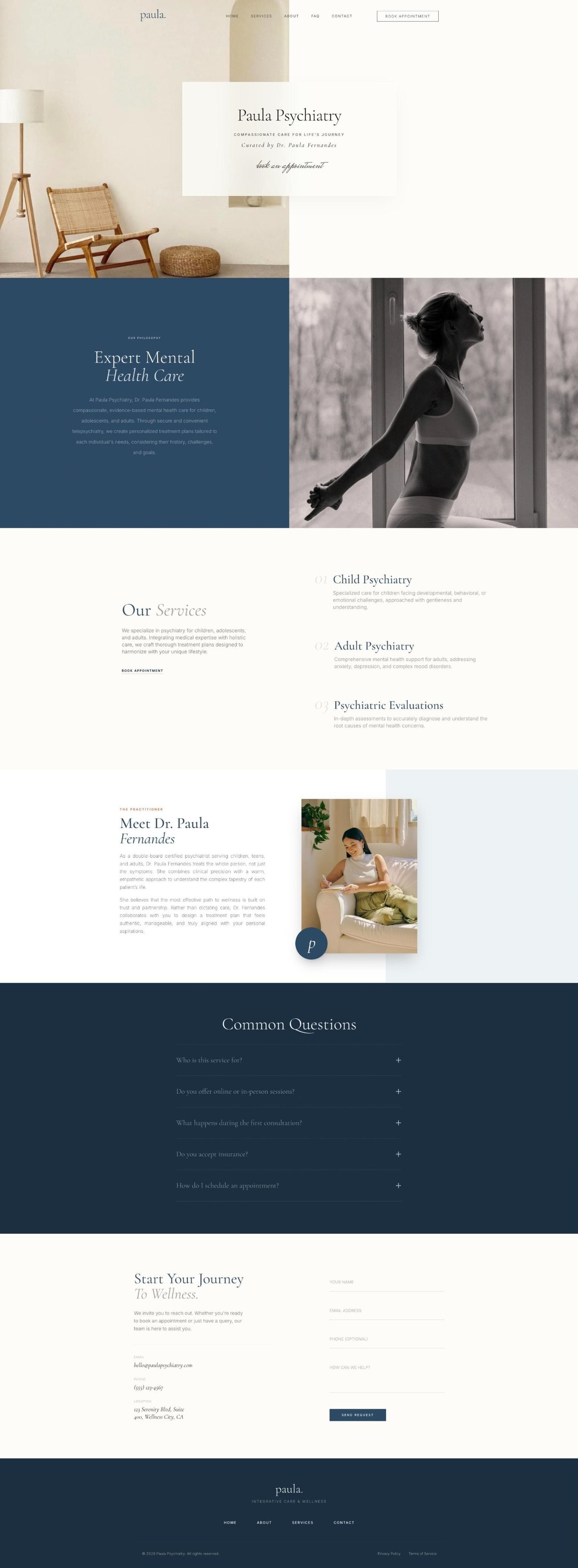
When you are starting out, the site can be small. One clear page can answer the questions that matter: who you help, how you work, online or in person, where you are licensed, fees or insurance, and how to book a first call. A one-page website designed for your practice is often the right size for the first year. You can add pages for each specialty later, when you know which clients you most want to reach.
If you want to see what goes on each part of the page, our guide to what to include on a therapist website goes through it section by section.
A new practice does not need a big website. It needs one that answers the first five questions honestly.
Claim your Google Business Profile
People often search "therapist near me" or "anxiety therapist" with their city. A Google Business Profile is the free listing that can show your practice on Google Maps and in those local results. Mentalyc's comparison of therapist directories lists both Google Business Profile and Bing Places as free.
Two details matter for therapists. First, if you see clients only online or from a home office, Google's help pages say businesses without a location customers visit must hide their address and show a service area instead, with up to 20 areas based on cities or postal codes. Second, Google says your profile only appears after you complete verification, so start that step early.
Use the same practice name, phone number and web address on your profile, your website and your directories. Matching details help Google understand that they all belong to the same practice.
Add one strong directory profile
Therapy directories can bring a new practice its first inquiries while your website starts to show up on Google. According to Mentalyc's comparison, Psychology Today costs $29.95 a month with no contract, GoodTherapy runs $30.95 to $49.95 a month, TherapyDen has a free basic profile and a $30 premium tier, and Therapist.com is free for 90 days, then $12.99 a month.
Start with one, and write it well. Use a warm, recent photo, describe your clients in their own words, mention your fees or the insurance you take, and link to your website. One complete profile tends to do more than several half finished ones. When you are ready to add more channels, our post on marketing for therapists covers what to do next, in order.
What it costs with Delas
If you would like help with the website step, these are our prices. Every site includes basic search setup and a design that works well on phones, and the site and domain stay in your name.
- Website in a Day: one page built from one of our templates, $497 with our launch offer until December 31, 2026 (regularly $697).
- One-Page Web Design: one page designed from scratch for your practice, $997 with the launch offer (regularly $1,297).
- Multi-Page Web Design: a full site with several pages, $1,697 with the launch offer (regularly $1,897).
- Visual Identity: logo, colors and fonts for your brand, $697 with the launch offer (regularly $897).
What can wait until you have clients
Starting a private practice already asks a lot of you. These things are worth doing, but not in the first month:
- A blog. Helpful articles can bring visitors from Google over time, but only if you keep writing. Add one once your week has a rhythm.
- Paid ads. Ads send people to your website. Wait until the site clearly explains who you help, or you pay for visits that do not turn into calls.
- Every social platform. Pick one only if you enjoy it. A clear website and one directory profile do more for most new practices.
- Testimonials. Check your professional code first, since many therapist codes have rules about asking clients for them.
When the five steps are done, add one question to every first call: "How did you find me?" After a few months, the answers will tell you where to put your time. If you would like us to look at your plans, contact us.
Questions about starting a practice online
Yes. Many therapists start with a directory profile and referrals. But people who hear your name will look you up, so a simple site should follow within the first weeks.
No. One site can explain both. Say clearly which states you are licensed in for online work and where your office is for in person sessions.
No. Google's own help pages say businesses without a place customers visit should hide the address and show a service area instead.
The NPI often arrives within a day, a Google profile and directory listing take an afternoon each, and a simple website can be ready in a day or a few weeks, depending on how you build it.