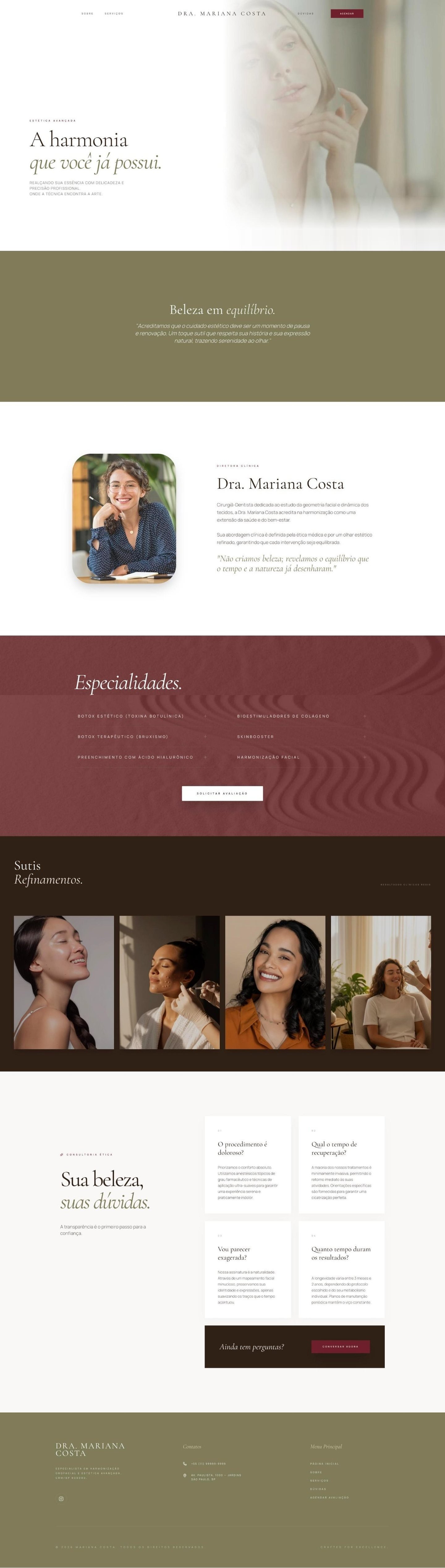
A med spa website has two jobs at once. It has to feel polished enough that someone trusts you with their face or skin, and it has to be clear enough that they can choose a treatment and book it in a few minutes. Many small clinics end up with the opposite: a beautiful homepage, then a long list of treatment names and a phone number.
Big clinic chains solve this with large agency websites. A small med spa does not need that. It needs a handful of well organized pages, honest words and a booking path that works on a phone. Here is what we put on every med spa website we design.
A homepage that says what you do and where
The top of the homepage should answer three questions right away: what kind of clinic you are, where you are, and how to book. "Medical aesthetics in Scottsdale, with injectables, skin treatments and laser" is more useful than a slogan alone. Put a clear booking button right beside it and repeat it as people scroll.
Below that, show your main treatment categories with a short line each, a warm photo of your team or your space, and one or two real details that set you apart, such as how consultations work or who leads the clinic.
One page for each main treatment
Treatment pages are where people decide. Each one should explain what the treatment is, who it suits, how long it takes, what recovery looks like, how many sessions people usually need and where the price starts. Add a short FAQ with the questions you hear in every consultation.
Separate pages also help you be found. Someone searching "lip filler in [your city]" should land on your lip filler page, not on a homepage where they have to search again.
Who performs each service
This detail matters more for med spas than for almost any other business. The American Med Spa Association explains that regulators pay attention to who actually performs each treatment, and that a clinic working with a physician must make that clear rather than simply advertising medical procedures. It also warns that titles like "medical aesthetician" or "licensed laser technician" draw attention when no such credential exists.
So name your providers, their real credentials and which services each one performs. A short team page with photos and qualifications builds trust and keeps your claims accurate.
Honest results, honest words
People want to see results, and before and after photos can help, as long as they are real photos of your own clients, shared with written consent. Keep the lighting and angles consistent, and do not edit the results.
Be just as careful with words. The American Med Spa Association says medical advertising should deal in facts, and that words like "best", "greatest" or "amazing" are likely to break state medical advertising rules. It adds that testimonials should stay accurate and limited to the client's experience, and that referral offers such as discounts for bringing a friend can conflict with patient solicitation laws in some states. When in doubt, check with someone who knows your state's rules before you publish.
A med spa website earns trust with facts: who does the treatment, what to expect and what it costs.
Prices and packages
You do not need a full price list, but a starting price for each treatment helps people decide whether to book a consultation. If prices depend on the area or the number of units, say so and give a range. Memberships and packages deserve their own short section, with what is included and how often clients come in.
Clear prices also save your front desk time. Fewer people call only to ask how much something costs.
Booking that works on a phone
Most people will book from their phone, often from Instagram. Weave's guide to med spa websites recommends online scheduling on the site and pages that load in about three seconds or less, and cites a Mercury News report saying more than half of visitors expect that speed and leave when a page is slower.
Link your booking button straight to the treatment or consultation, not to a page with every service you have ever offered. Use the same button everywhere, and make sure it is easy to tap with a thumb.
The small details that build trust
- Your address with a map link, parking details and opening hours.
- A short note on how consultations work and whether they are free.
- Your cancellation policy, written kindly and clearly.
- Real photos of your space, so the first visit feels familiar.
If you would like a site like this, a multi-page website gives each treatment its own page, and our Website in a Day is a fast start for a smaller clinic. We wrote more about what makes visitors trust a wellness website, and you can see our aesthetics work in our portfolio.
Questions med spa owners ask
They help people picture results, but use only real photos of your own clients, with written consent, and keep them honest. Check your state's medical advertising rules before you publish them.
For your main treatments, yes. A page each for injectables, facials, laser or body treatments helps visitors find what they want and helps Google show the right page for each search.
Showing a starting price for each treatment usually helps. People who cannot find any number often assume it is out of their range and leave without asking.
Avoid it. The American Med Spa Association warns that words like "best" or "amazing" in medical advertising can break state rules. Describe facts instead.
A polished website for your clinic, built to book.
Website in a Day, from $497 (launch offer until Dec 31, then $697).
See the options