
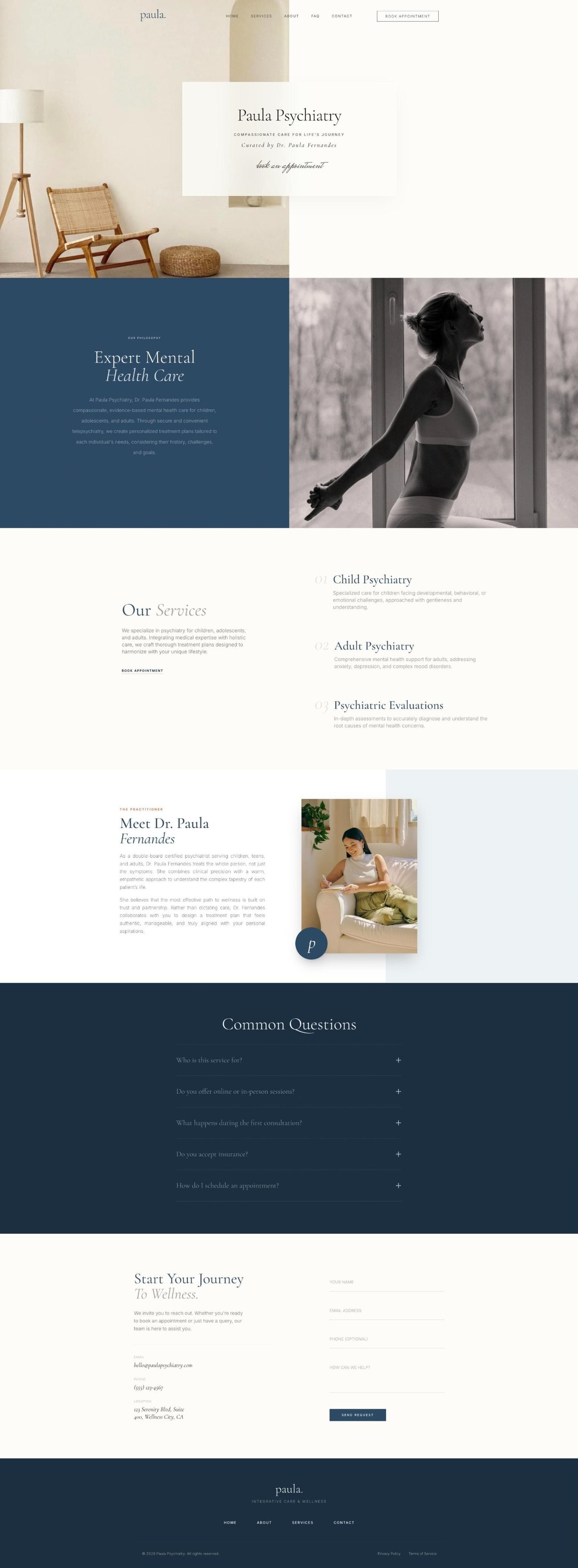
Look at a dozen good psychologist websites and they seem to have little in common. Some are bright and airy, some are dark and quiet, some are one page and some have twenty. But underneath the design, the ones that bring in clients make the same few choices.
XR Health's guide to websites for psychologists lists many of them: a domain with your name, a clear niche, a professional photo, keyword-rich titles for the problems you treat, easy contact and regularly published original articles. Here is how those choices look in practice, and how to apply them to your own site.
A clear niche, said in plain words
The best psychologist websites say who they help in the first line. Not "individual, couples and family therapy", but "therapy for adults with anxiety and panic, online across Ohio." XR Health recommends a clear niche with each specialty well described and the target client's concerns addressed.
A clear niche does not mean turning everyone else away. It means the right person recognizes herself in the first sentence, which is often what decides whether she keeps reading.
A real, warm photo
Choosing a psychologist is personal. People want to see who they will be talking to. XR Health suggests a professional photo that conveys seriousness, trust and empathy. In practice, that means a recent, natural photo in good light, ideally in your office or a calm space.
Place it near the top of the homepage and again on the about page. A face answers "is this someone I could talk to?" faster than any paragraph.
Specialties explained, one by one
Good sites give each main specialty its own section or page: what it is, who usually seeks help with it, how you work with it and how to book. XR Health recommends keyword-rich titles and descriptions for the problems you treat, which helps both visitors and Google.
Write in your clients' words. People search for "help with panic attacks", not for the name of a treatment. If you use an approach like CBT or EMDR, explain it in one plain sentence.
Credentials that build trust, without a wall of acronyms
Your license, training and experience matter. They answer "is this person qualified?" Good sites show them clearly on the about page, with links to professional profiles and publications where relevant, as XR Health suggests, but they do not lead with them. The first thing visitors read is about the visitor.
If you are still writing your about page, our guide to therapist bio examples walks through a simple structure.
Contact that takes seconds
Every good psychologist website makes the next step easy: one clear button, the same on every page, leading to a short form or a booking link. Say whether you offer a free consultation call, how quickly you reply and whether you see clients online, in person or both.
Never ask for health details in the contact form. That conversation belongs in your first call. Add a short note that the form is not for emergencies, with where to go instead.
The best psychologist websites feel like a calm first conversation: clear about who they help, and easy to say yes to.
Fees and how sessions work
Good psychologist websites answer the practical questions before anyone has to ask: how long sessions last, what they cost or where to find that information, whether you take insurance or provide superbills, and your cancellation policy. Clear details answer the silent question "can I afford this?" before it becomes a reason to leave.
If your fees vary, give a range or a starting point. Visitors who find no information at all often assume the worst and keep searching.
Regular articles that bring clients
This is where the best sites pull ahead over time. XR Health recommends regularly published, original articles that are useful to the public, with links to quality sources and to relevant pages on your own site. Each article that answers a real question, such as "how do I know if I need therapy for anxiety?", is one more way for people to find you on Google and in AI tools.
The hard part is keeping it up while running a practice. That is exactly why we are opening Rooted SEO: we write and publish search-optimized articles on your site every day, so it keeps growing without you writing a word. It opens soon, and you can join the waitlist.
Bringing it together
If your current site is missing several of these, start with the first lines of your homepage, your photo and your contact path. Those three changes make the biggest difference fastest. A one-page website designed from scratch can hold all of them, and a multi-page website gives each specialty its own page. You can see how we design for psychologists in our portfolio.
Questions psychologists ask
Your own name is often the simplest choice for a solo practice. It is easy to find, easy to remember and stays with you if you move or change focus.
Regularly enough that new ones keep coming. Steady, useful articles are one of the strongest ways to be found on Google. If you do not have time to write, our Rooted SEO service, opening soon, publishes them for you every day.
Check your ethics code first. The APA Ethics Code says psychologists do not solicit testimonials from current therapy clients, so most psychologists rely on credentials, a clear approach and articles to build trust.
A calm, clear website for your practice.
Website in a Day, from $497 (launch offer until Dec 31, then $697).
See the options