
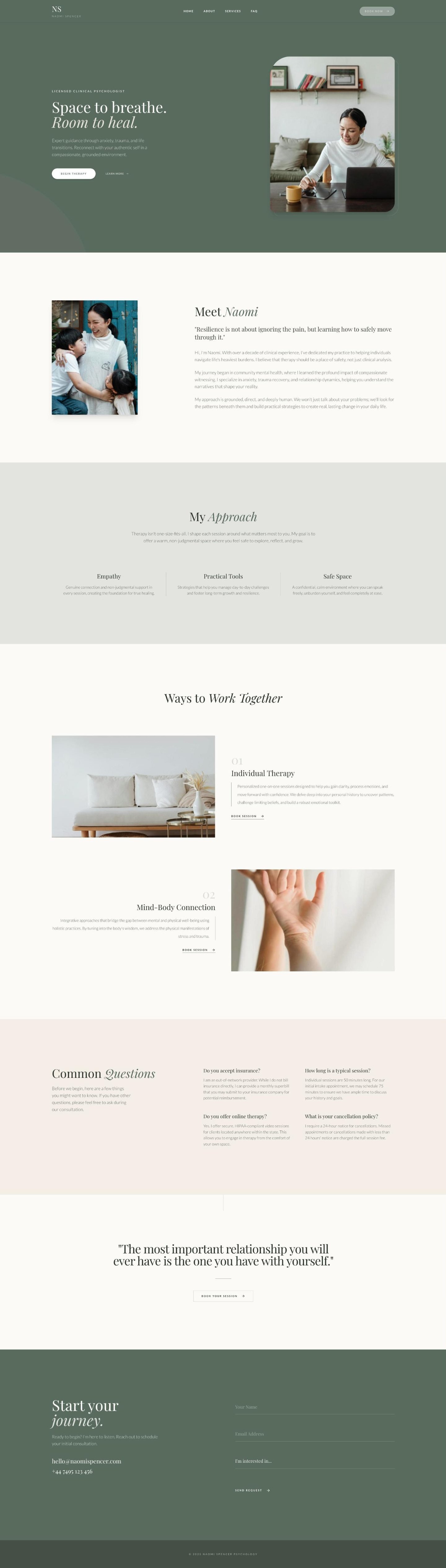
You have decided it is time for a real website. Maybe your current one was a quick DIY project, maybe you only have a directory profile. Now you are searching for psychologist website design and finding agencies, template shops and freelancers who all promise the same thing.
The hard part is not finding a designer. It is knowing what to ask so you end up with a site that brings in the right clients, stays in your name and does not turn into a project you regret.
The short answer: before you hire, decide what the site must do and gather your basics. Then choose a designer who already works with psychologists, and ask four things in writing: who owns the domain and files, how the contact form protects privacy, how long it takes and how many changes are included, and how you will update it after launch.
Decide what the site must do before you talk to anyone
A designer can only build what you can describe. Before the first call, write down three things: who you help, in one sentence ("adults with anxiety, online across Texas"), what you want a visitor to do (book a free 15 minute call, send a message, join a waitlist), and which specialties need their own space.
This is what separates good web design for psychologists from a site that only looks nice. A web design handout for psychologists on the APA website, taken from Marketing for Therapists, says the main goal of the site is to get clients to book a first session, and that users spend 80% of their time looking at the content above the fold. So the most important decision is what a visitor sees before scrolling: your niche, your photo and one clear button.
If you want to see how good sites handle this, our guide to what the best psychologist websites have in common walks through it.
Choose a designer who already works with psychologists
Look at the portfolio first. You are not looking for your own taste in every project, you are looking for sites that feel calm, read easily and make the next step obvious. The same APA handout recommends large text, 16px or so, short paragraphs, no carousels and no "psychobabble". If a designer's work for other practices does that, she will likely do it for you.
Then listen to how she talks about your work. A designer who understands psychology website design will ask about your niche, your ethics rules and how clients usually find you, not only about colors. She will also know that reviews need care: for psychologists, use unprompted reviews, quoted with the client's OK and signed with a first name, like "Mariana". What the APA code rules out is asking current clients for testimonials.
Ask who owns the domain, hosting and files
This is the question we would ask first, and the one most people skip. Your domain (yourname.com) should be registered in your name, with your own login. The same goes for hosting, the service that keeps the site online. If the designer registers them for you, ask to have them transferred to you at launch.
Ask what happens to the site if you stop working together. You should be able to keep it, move it or hire someone else without starting over. In every Delas project, the site and the domain stay in your name.
A website you do not own is a website you are renting from your designer.
Ask how the contact form protects privacy
A contact form for a psychologist is not like a form for a bakery. Azuro Digital, an agency that designs for psychologists, recommends that only name and email be required. We agree, and we would add one rule: never ask for health details or symptoms in the form. That conversation belongs in your first call.
Ask the designer to add two short lines near the form: when you usually reply, and that the form is not for emergencies, with where to go instead (in the US, the 988 Suicide and Crisis Lifeline, which Azuro also names). If you use a booking or practice management tool, ask whether the site links to it or embeds it, and keep intake forms inside that tool.
Ask about timeline, changes and who writes the words
Ask for the timeline in writing. WP Creative, an Australian agency that designs psychology websites, says its projects take 4 to 8 weeks on average. Template based options can be much faster: our Website in a Day is designed and online in one day.
Then ask how many rounds of changes are included and what happens after that. Ask who writes the words on the page. Many delays come from text, not design, so know whether you are expected to send finished copy, notes, or nothing at all. If you need help with your about page, our therapist bio examples give you a structure to start from.
Ask how you will update the site after launch
Your fees will change, you will add a specialty, you will want a new photo. Ask whether you can change texts and photos yourself, without calling the designer every time, and how long support lasts after launch. Every Delas site comes with a simple panel where you edit your texts, photos and colors.
Also ask how the site will keep growing on Google. Basic SEO (titles, descriptions, structure and a fast mobile version) should be part of any good design. After that, what grows visibility is a steady flow of articles that answer the questions your clients search for. That is why we are opening Rooted SEO: we write and publish search-optimized articles on your site every day. It opens soon, and you can join the waitlist.
What it costs with Delas
These are our own prices. Every site includes basic SEO and a design that works well on phones, and the site and domain stay in your name.
- Website in a Day: one page built from one of our templates, $497 with our launch offer until December 31, 2026 (regularly $697).
- One-Page Web Design: one page designed from scratch for your practice, $997 with the launch offer (regularly $1,297).
- Multi-Page Web Design: home, about, specialties, fees and contact as separate pages, $1,697 with the launch offer (regularly $1,897).
For most solo psychologists, a one-page website designed from scratch is the sweet spot: room for your niche, your approach, your fees and a clear way to book. You can see how we design for therapists in our portfolio, or contact us and bring your questions from this list.
Questions before hiring a designer
Five things. Your niche in one sentence, a recent photo of you, your license and training, your fees and session format (online, in person or both), and links to two or three websites you like.
A template if you want to be online this month with one main service; a design from scratch if you have several specialties or want the site to feel clearly like you. Both can look calm and professional, the difference is how much is shaped around your practice.
Three. The domain registered in the designer's name, no examples of therapy or health websites, and a contact form that asks visitors about symptoms. Any one of them is worth a direct question before you sign.
A calm, clear website for your practice, designed with you.
Website in a Day, from $497 (launch offer until Dec 31, then $697).
See the options