
Starting a private practice as a dietitian means juggling two lists at once. One is the business list: liability insurance, a business structure, maybe insurance credentialing. The other is the online list, which is how people will actually find you and book. Most guides cover the first in detail and the second in one line.
This checklist is for the private practice dietitian who wants the online side done well, without spending months on it. These are the steps we walk through with nutrition professionals opening their own practice, in the order we suggest.
Choose who you help first
Every online step is easier once you know who you are talking to. "Nutrition support for women with PCOS" or "dietitian for busy parents with picky eaters" gives your website, your Google profile and your social bio a clear message. TheraPlatform's guide for dietitians starting out recommends choosing a target client and niche, and notes that you can refine it after your first 6 to 12 months.
Write one sentence that says who you help and with what, in your client's words. You will use it everywhere, so it is worth getting right.
Check the rules for where you will work
If you plan to see clients online, check where you are allowed to do it before you promise it on your website. The Academy of Nutrition and Dietetics advises dietitians to review the telehealth regulations of every state where they provide services, and points to its own summary of state licensure rules for details.
Then write the answer clearly on your site: "Online sessions for clients in Texas and Oklahoma" is far more useful to a visitor than "virtual sessions available".
Get your name, domain and email
Settle your practice name, then buy a matching web address (the domain) and set up an email on it, like hello@yourpractice.com. Using your own name, like "Maya Chen Nutrition", avoids most naming problems and stays with you if your focus changes. Register the domain in your own name, whoever builds the site.
Build a simple website before you need it
People who hear about you from a doctor or a friend will look you up before they book. TheraPlatform lists building a website and professional social pages as one of the first steps of a new practice, and we agree: it does not need to be big, it needs to be clear.
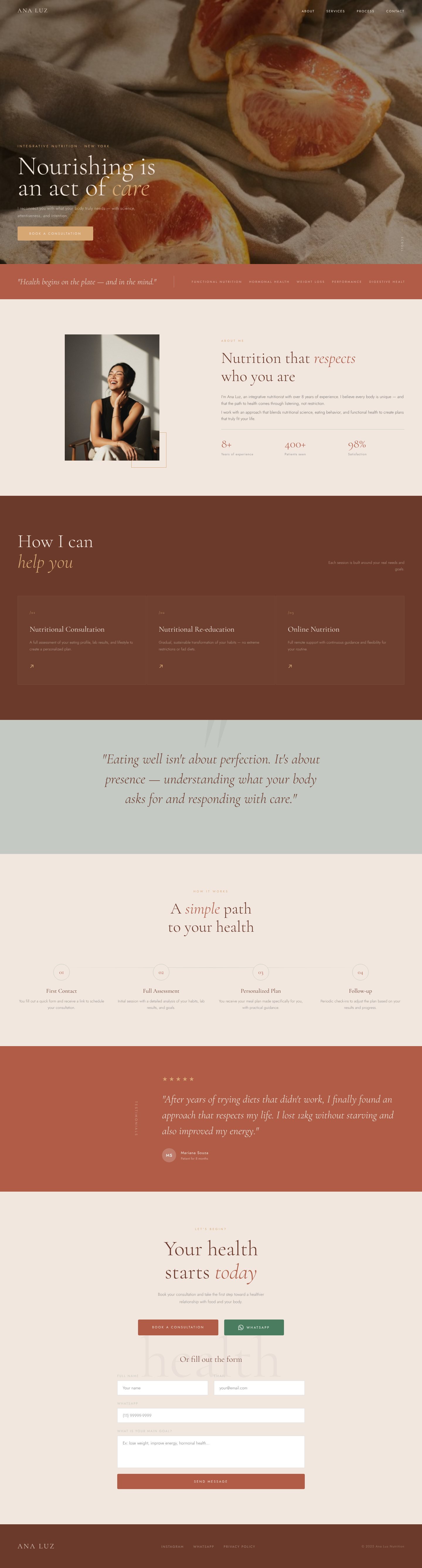
One page can hold everything a new practice needs: who you help, how you work, online or in person, your main programs with a starting price, a short story with a warm photo of you, and one booking button repeated through the page. You can add separate pages for each program later, once you know which ones clients choose most. We wrote about the small details that make a site feel reliable in what makes visitors trust a wellness website.
A new practice does not need a big website. It needs a clear one, and a button that works.
Set up booking and a short intake
Choose how people will book their first conversation. Many dietitians use the scheduling built into their practice management software. Whatever you use, link straight to one free call type, say how long it lasts and what happens during it.
Keep the booking form short: name, email or phone and a preferred time. Leave health history for the intake you send after booking, through a secure tool. If you decide to accept insurance, TheraPlatform notes that this also means following HIPAA, so choose software that supports it.
Claim your Google Business Profile
Your Google Business Profile is the free listing that shows practices on Google Maps and in local results. Google says complete and accurate profiles are more likely to show up, and that verification tells Google you are allowed to represent the business. If you work only online or from home, show a service area instead of an address.
Use the same name, phone and website on your profile, your site and any directory. Matching details help Google understand they all belong to the same practice. Our plain-language guide to SEO for therapists explains how local results work, and the same steps apply to nutrition practices.
Tell the people who already meet your clients
Your first clients often come through people, not search. Family doctors, OB GYNs, therapists, personal trainers and pediatricians all meet people who could use your help. A short, friendly email with your one sentence and a link to your website is enough to start. Healthie's checklist for new nutrition businesses sets a simple first goal, your first five clients, and that is a good way to think about these early weeks.
What can wait
- Every social platform. Pick one, and only if you enjoy it.
- A blog. Useful later, once your week has a rhythm.
- Paid ads. Wait until the site clearly explains who you help.
If you would like help with the website step, our Website in a Day builds a full page from one of our templates and goes live in a day. You can see our nutrition work in our portfolio or contact us to talk about your practice.
Questions dietitians ask about starting out
Not necessarily, but people who hear your name will look you up. A simple one page site in the first weeks makes those referrals much easier to turn into calls.
It depends on the rules of each state. The Academy of Nutrition and Dietetics advises reviewing the telehealth regulations of every state where you provide services.
Choosing a focus helps your website and your marketing, but it does not have to be permanent. TheraPlatform suggests you can refine it after your first 6 to 12 months.
One free call type, how long it lasts, and what happens during it. Keep the form short and do not ask for health details before the first conversation.
A website that books discovery calls while you work.
Website in a Day, from $497 (launch offer until Dec 31, then $697).
See the options